10 lessons of implementation
AI success starts before the model
What businesses are learning after the first wave of AI adoption.
Lessons observed across real AI implementations.
Still deciding whether AI is for you? Start with Do I need AI?
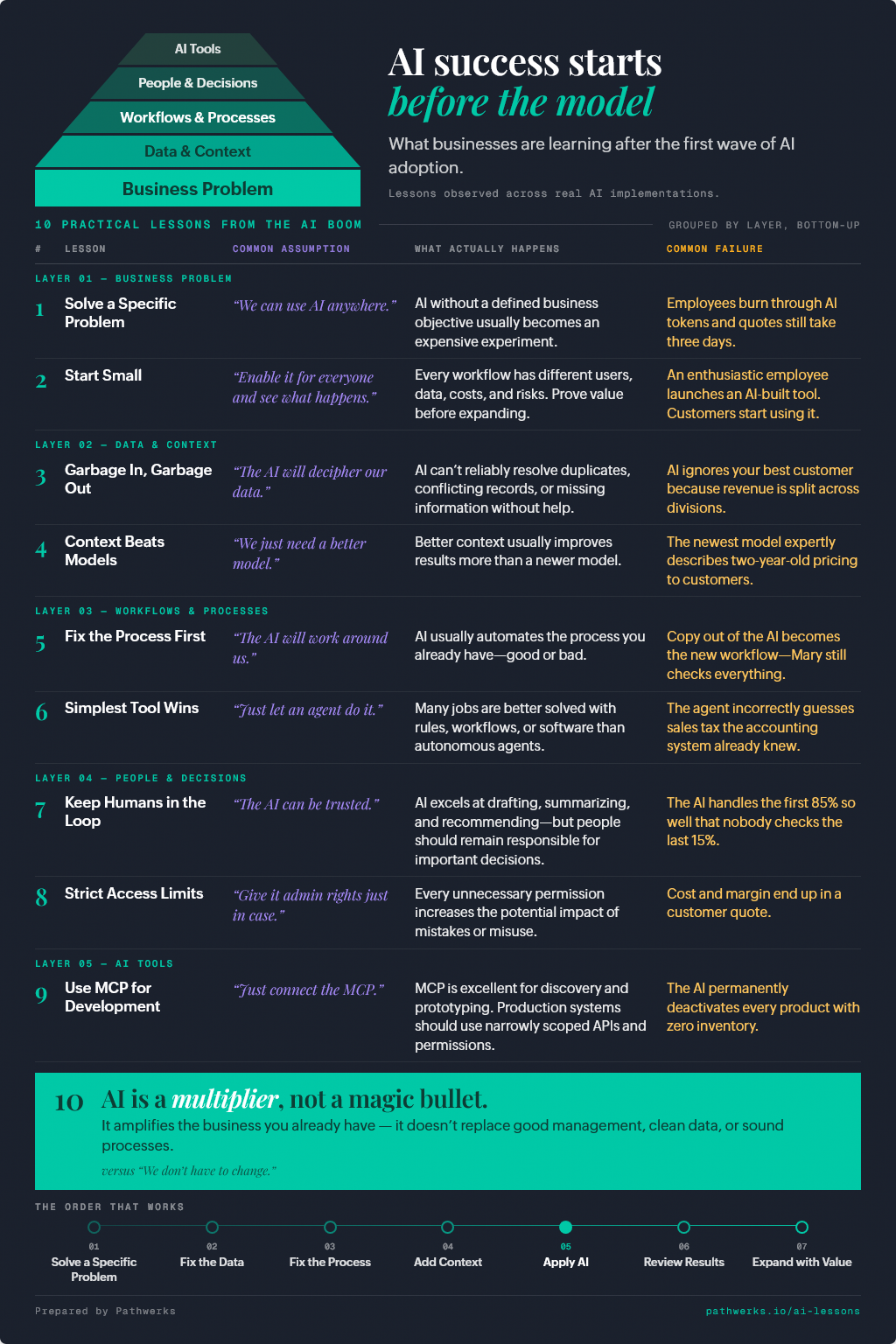
The stack
Five layers. The tool is the last one.
Ten lessons came out of the first wave of adoption, and each one belongs to a layer of this stack. The rest of this page walks up it, one layer at a time.
Read bottom-up ↑
Layer 01 / 05 — Business Problem
Nothing above this layer matters until there is a problem worth solving.
Lesson 01
Solve a Specific Problem
versus “We can use AI anywhere.”
What actually happens
AI without a defined business objective usually becomes an expensive experiment.
Common failure
Employees burn through AI tokens and quotes still take three days.
Lesson 02
Start Small
versus “Enable it for everyone and see what happens.”
What actually happens
Every workflow has different users, data, costs, and risks. Prove value before expanding.
Common failure
An enthusiastic employee launches an AI-built tool. Customers start using it.
Layer 02 / 05 — Data & Context
The model can only work with what your records actually say.
Lesson 03
Garbage In, Garbage Out
versus “The AI will decipher our data.”
What actually happens
AI can’t reliably resolve duplicates, conflicting records, or missing information without help.
Common failure
AI ignores your best customer because revenue is split across divisions.
Lesson 04
Context Beats Models
versus “We just need a better model.”
What actually happens
Better context usually improves results more than a newer model.
Common failure
The newest model expertly describes two-year-old pricing to customers.
Layer 03 / 05 — Workflows & Processes
AI inherits the process you drop it into.
Lesson 05
Fix the Process First
versus “The AI will work around us.”
What actually happens
AI usually automates the process you already have—good or bad.
Common failure
Copy out of the AI becomes the new workflow—Mary still checks everything.
Lesson 06
Simplest Tool Wins
versus “Just let an agent do it.”
What actually happens
Many jobs are better solved with rules, workflows, or software than autonomous agents.
Common failure
The agent incorrectly guesses sales tax the accounting system already knew.
Layer 04 / 05 — People & Decisions
Someone stays accountable for what the output causes.
Lesson 07
Keep Humans in the Loop
versus “The AI can be trusted.”
What actually happens
AI excels at drafting, summarizing, and recommending—but people should remain responsible for important decisions.
Common failure
The AI handles the first 85% so well that nobody checks the last 15%.
Lesson 08
Strict Access Limits
versus “Give it admin rights just in case.”
What actually happens
Every unnecessary permission increases the potential impact of mistakes or misuse.
Common failure
Cost and margin end up in a customer quote.
Layer 05 / 05 — AI Tools
The last decision, not the first.
Lesson 09
Use MCP for Development
versus “Just connect the MCP.”
What actually happens
MCP is excellent for discovery and prototyping. Production systems should use narrowly scoped APIs and permissions.
Common failure
The AI permanently deactivates every product with zero inventory.
Lesson 10 — the one that contains the rest
AI is a multiplier, not a magic bullet.
It amplifies the business you already have — it doesn’t replace good management, clean data, or sound processes.
versus “We don’t have to change.”
Steps 06 and 07
Then it becomes a habit.
The order that works
Step 06
Review Results
Check the output against what you expected on a schedule, not on a hunch. The failures above are all things a regular review would have caught.
Step 07
Expand with Value
Add the next workflow once the current one has proven it saves time or money. Then start again at the bottom of the stack.
Want to know which layer your business should start with?
We practice what this page preaches: our AI use, access, and oversight policy is public, and our AI-assisted deduplication case study shows where AI actually earns its keep.
Schedule a Free Consultation