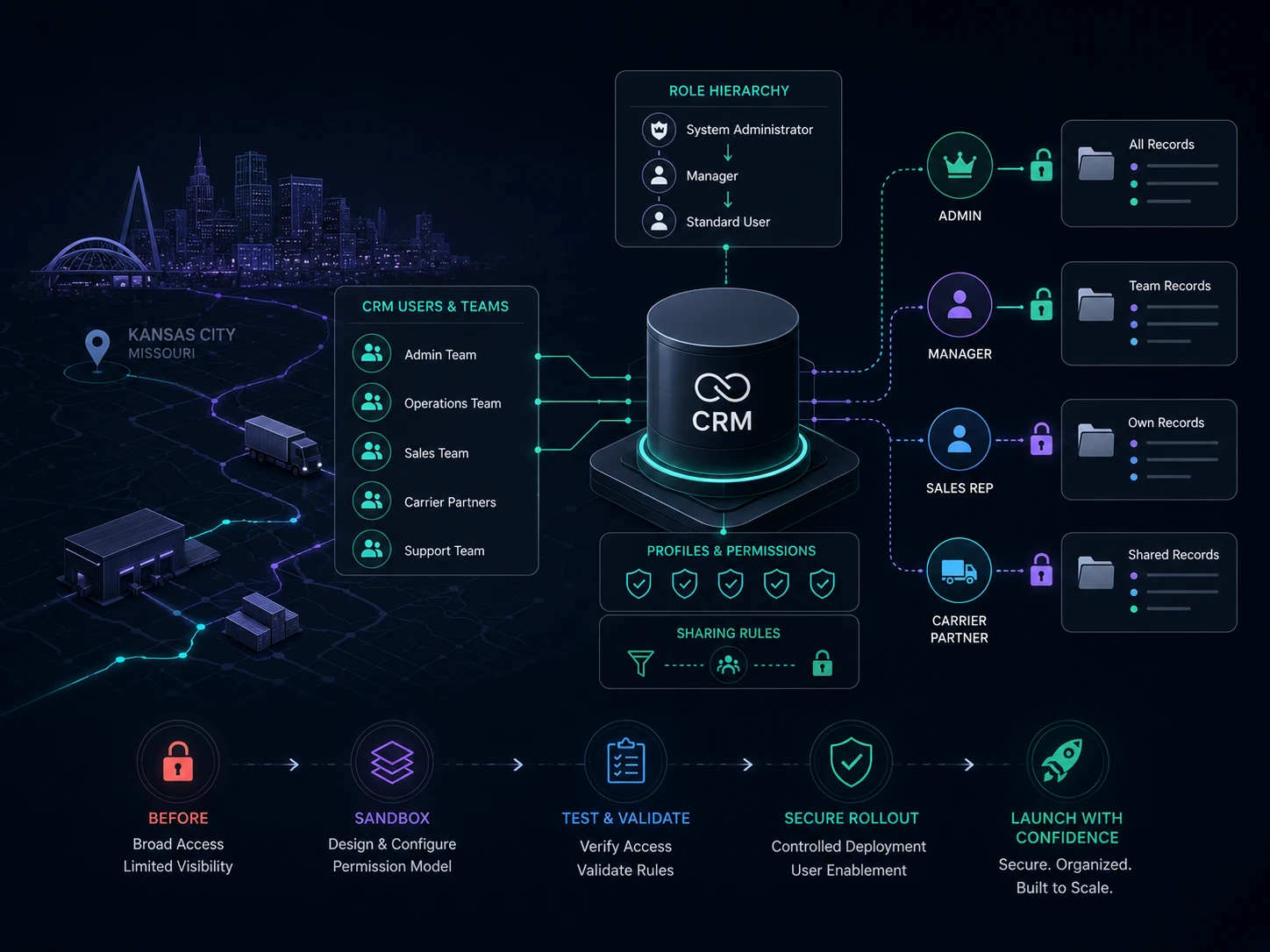
Two constraints shaped the approach. The client's legal team would not allow a consultant to work in production data; everything had to be built in a Zoho CRM sandbox with fabricated test records. This was 2022, before AI-generated test data was a practical option, so the fake data had the limitations you would expect — uniform names, obvious patterns, edge cases that didn't exist until we constructed them by hand. And sales operations couldn't be interrupted, which meant cutover had to land cleanly in a single window.
Phase 1: Discovery in meetings.
The bulk of the project's hours were spent with the internal admin team, walking through specific scenarios. What does a regional manager see when they open the Deals module? What does an account executive see when their teammate is reassigned? What needs to be invisible to teams outside the new program? Most of the answers were sparse enough to raise suspicion. Whenever a permission matrix is clean and simple, it almost never reflects reality, especially for an organization of that size.
Phase 2: First build, rolled back.
We built the matrix in the sandbox against the design the admin team provided. When we got to implementation, several scenarios didn't behave the way the users required. Unfortunately, migration day was the first time we had heard of most of those requirements. To complicate matters, the admin team's testing of the first build was light — light enough that even the known requirements were not all implemented correctly. Work effectively stopped, and the matrix was immediately rolled back.
Phase 3: Independent validation.
The second attempt required a new approach. Zoho CRM sandbox permits up to five developer seats. One was ours. We used the remaining four to spin up test accounts and assigned them across the role and profile combinations that hadn't been exercised. Running through real scenarios as those test users surfaced cases the original design hadn't accounted for — interactions between roles, sharing rules, and field-level access that nobody had a reason to think about before the new program made it necessary. Doing that pass ourselves, rather than waiting on internal testing cycles, is what got the second build to a defensible place.
Phase 4: Rebuild and go-live.
The rebuild was done in the open. Rather than design the matrix privately and hand over a finished artifact, we built it on a shared Miro board so the admin team could follow every decision as it was made. There were no trade secrets to protect — none of the design was treated as proprietary or kept back, and the transparency was deliberate. We created a profile for each of the dozen or so internal teams — sales reps, sales managers, senior management, marketing, admins, and the rest — and laid them out across a series of grids: one to compare what each team could see, another for what each team could do. Putting it in that form made the gaps and overlaps obvious at a glance, which is exactly what the under-specified first design had been missing.
This time the testing was not left light. We assigned the sandbox developer accounts to the admins themselves and had them log in as mock users under a range of role and profile assignments, working through real scenarios. The people who would own the system after we left were the ones exercising it.
With the matrix validated, sharing rules and role hierarchy changes were sequenced to apply in a single low-traffic window. Cutover landed without interrupting operations. A few minor adjustments were needed on go-live morning — nothing significant — and the new program launched with its data properly separated from the rest of the business, albeit delayed.