case study / Zoho CRM Blueprint / Wichita, Kansas

A Zoho CRM implementation in Wichita proved what every CRM case study gets wrong.

The standard version goes like this: the old system was a problem. The client bought the right software. We implemented it properly, ran training, and after go-live the team embraced the change. Here are the results.

Almost none of that is true, and our work with a Wichita manufacturer of interpretive signage was a perfect example.

Zoho CRM Blueprint order management workflow for a Wichita sign manufacturer

At a glance

Industry
Manufacturing
Location
Wichita, Kansas
Year
2023
Engagement
Piecemeal Zoho CRM Blueprint implementation for a manufacturer running its entire order lifecycle on physical folders.
Products
Zoho One, Zoho CRM, Zoho Campaigns, Zoho WorkDrive
Key takeaway
A business isn't wrong for trusting a system it built, questioning a consultant it just met, or absorbing change gradually.

1. "The old system was broken."

That's how every CRM case study starts — and for good reason. It makes the decision to change feel obvious and the consultant's arrival feel necessary.

It is almost never accurate, and it misrepresents the actual decision any business owner faces.

If a company has been in operation for twenty years, something is working. Usually more than something. The honest question is never broken versus not broken. It's whether the costs of the current system — always distributed and invisible and therefore difficult to judge — are greater than the costs of an uncertain change.

What this looked like in Wichita.

Our client manufactures custom interpretive signs for botanical gardens, nature centers, and other cultural institutions. Previously, every job lived in a manila folder: the specifications, a printed copy of the artwork, every estimate, the final invoice, and so on. A sticker checklist on the front tracked which stages the job had cleared, when, and by whom. Folders were sequentially numbered by client and had been accumulating in a wall cabinet for two decades.

Importantly, this system was not "broken." It had a clear logic. The owner understood at a glance what any folder represented and knew how to navigate twenty years of production history. What he was being asked to give up — by a Zoho consultant he had only just met — was a tangible record of everything his shop had ever made, organized in a way that made complete sense (to him). When your business is your livelihood and your life savings, reluctance is not irrational.

At the same time, the maintenance costs for this system were not trivial: folders that migrated around the office and had to be hunted down, documents maintained in three locations simultaneously with no authoritative version, job status that was only knowable if you could put your hands on the physical folder. Those costs are real but they are never experienced in total. There is no practical way to sum the cumulative time spent searching for folders or calculate the overhead of keeping a Gmail structure, a Microsoft OneDrive, and a physical cabinet all nominally in sync. The case for change was not that the system was broken. It was that the costs had become worth the effort of addressing.

2. "The missing piece was better software."

The standard case study is usually written to sell something — a platform, a product, a methodology. The implied argument is that the client lacked the right tool and the right tool was provided. This is a comfortable story for consultants to tell and a convenient one for software vendors to sponsor. It is less often true.

Most small businesses are rarely missing functional software. (In fact, more often than not, they are paying for duplicative services.) What they are missing is a working configuration of software they already own, or already partially deployed, or already paid someone to set up.

What this looked like in Wichita.

This client was already on Zoho One. A previous implementation partner had configured Zoho CRM and Zoho Books. The CRM was in use — as a contact database. Records existed. The software was running. What was absent was any meaningful connection between the CRM and the actual work of the business: quoting, production, shipping, invoicing. The contacts sat there. The folders kept moving.

Consider what that situation looks like from the owner's side of the table. He had already been through one implementation. A nationally-recognized consulting firm had already been engaged. The CRM had already been set up. Why would he believe another Zoho partner making the same general argument — that the CRM could do more, that the process could be better, that the disruption would be worth it. Given the history, a reasonable skepticism is appropriate.

What the engagement required was not new software. It was something more artful: building the order workflow, creating the Blueprint that mapped to the real production process, and connecting Zoho Campaigns so that the contact records sitting idle in the CRM could finally serve a purpose. The tools were already present. They just needed to reflect the business.

3. "Implementation is a defined project, followed by adoption."

This project model is the most persistent fiction in CRM consulting.

Define scope. Build the system. Run training. Execute go-live. Measure adoption.

Clean phases, a clear handoff, results to follow. This model exists because it is easy to describe, easy to sell, and easy to invoice against. It is not real.

Consider what the project model asks of a business owner. It asks them to trust someone they have only recently met to redesign the machine that pays their mortgage, accept concentrated disruption at go-live, and absorb whatever goes wrong during the transition — all while continuing to run their operation at full capacity. At enterprise scale there are change management teams, project sponsors, and redundant staff capacity to mitigate those risks. At small business scale there is the owner, and the go-live is a wager. Caution does not equal obstruction.

What this looked like in Wichita.

There was no project scope. No kickoff meeting. No training day. No go-live date. The Zoho CRM implementation happened in fits and starts over nearly two years, driven by a mix of deliberate pressure (mostly from us) and opportunistic problem-solving. When a gap surfaced that the system could close, we closed it. When the business was ready for the next step, we took it.

This is important: for most of that period, both systems ran in parallel. The folders did not stop when the Blueprint started. That meant the CRM was, for a significant stretch of time, additional work — a second system to maintain alongside the one the team already trusted and understood. This is the part the "standard project model" never honestly accounts for: the period where the new system costs more than it saves, before it saves anything at all. That period is real, and pretending it doesn't only benefits the consultant. By the time the business realizes the truth, the check has been cashed.

What made the piecemeal approach work was that it distributed the disruption rather than concentrating it. No single moment required the business to bet everything on the new system working. Each increment was small enough to absorb. The old system didn't get replaced — it got displaced, gradually, until one day it stopped organically.

That took longer than a go-live would have. The old system, when its costs are honestly totaled, was more expensive to the business than it appeared — and the piecemeal implementation, spread across two years, cost more in total consulting hours than a concentrated project would have, but it also financed significantly lower risk without a single large cash payment.
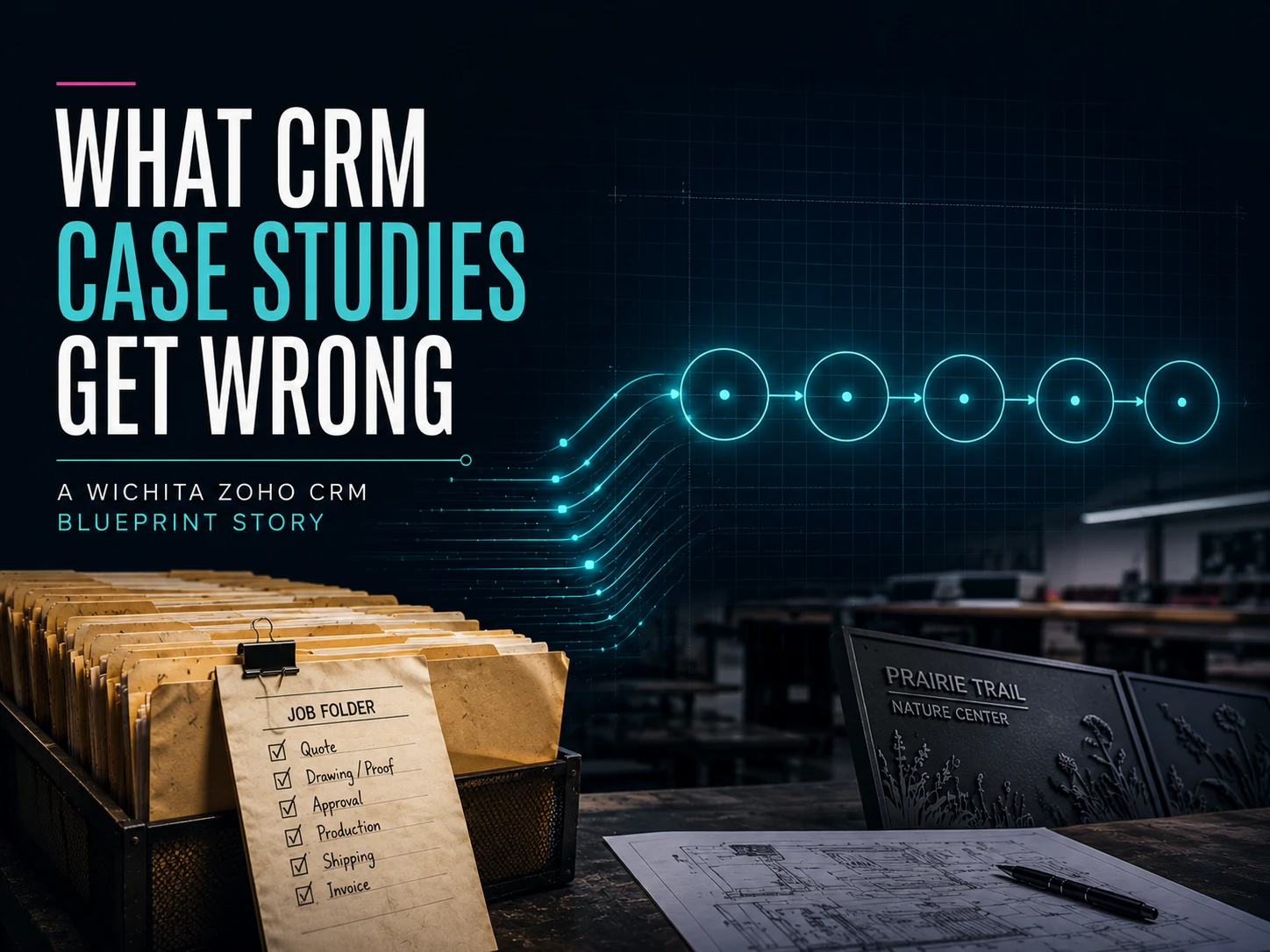
What the Zoho Blueprint replaced.

A Zoho CRM Blueprint is a workflow engine: it defines the states a record can be in, the transitions between them, and what must happen before a record can advance. In this case it effectively replaced the sticker checklist on the front of the manila folder — the manual tracking mechanism that had governed every job for twenty years.

The shop runs two primary product lines. The classic line — interpretive botanical panels — follows a straightforward path from quoting through approval, pre-production, in-house fabrication, shipping, and invoicing. The second line, a full-color outdoor laminate mounted on a welded steel post, routes through a design approval phase and an outside processor before returning to the shop for assembly and finishing. The Blueprint handles both paths, including back-transitions for jobs that need to be revisited and exception routes for cancellations and remakes.

Every active job now moves through defined stages in the CRM. Specifications that lived on paper inside a folder live on the record. Job history that required locating the right folder in a two-decade-deep cabinet is searchable in seconds. With Zoho Campaigns connected and the CRM sync active, the contact records the team had been maintaining for years — originally migrated from a standalone contact management platform — now feed actual outreach rather than sitting idle in a database.

What changed.

The folders are gone. That took longer than the implementation itself — but it happened. Microsoft OneDrive is gone. Documents now live in Zoho WorkDrive, attached to the records they belong to. Gmail folders are still present but only sporadically used. Three parallel document locations became 1.25.

The outcome, stated directly.

No benchmarking was established at the start of this engagement — it rarely is at this scale, and in a piecemeal process that spans two years alongside other business changes, a clean before-and-after comparison does not exist. What we can say: a near-30% productivity improvement is a conservative estimate, but we'd rather not over-claim. The specific, recurring costs of the old system — the folder hunts, the overhead of three document locations, the manual checklist discipline, the hard constraint that job status required physically locating a folder — are gone. The business handles its work with materially less labor per unit of output.

That result did not arrive on a go-live date. It accumulated over time, increment by increment, in a process that looked nothing like what most CRM case studies describe. Which is, in the end, the point.

Running Zoho in Wichita or anywhere in the region and ready to put it to work? Let's talk.

Start a Conversation